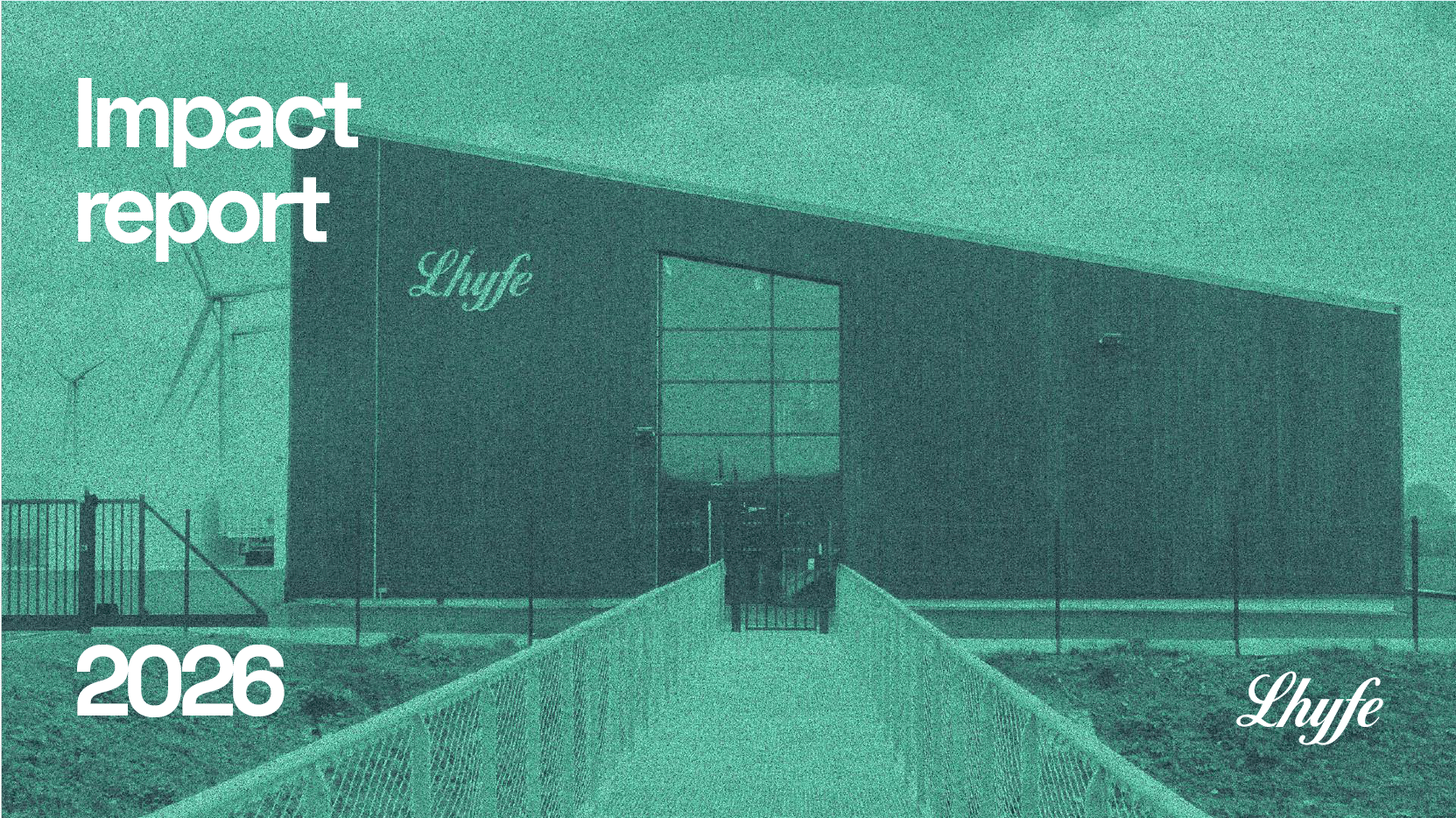
To create a more breathable world for future generations, Lhyfe has chosen to make this document accessible to as many people as possible, without the need for a contact form or any obligation. It is available free of charge, so that anyone can view it immediately. The aim is simple: to share our approach in the most direct, open and transparent way possible.
Discover Lhyfe’s 2026 Impact Report.
The acceleration of the energy transition raises key questions: energy traceability, measuring real impact, effective contribution to decarbonisation, and the role of businesses in transforming energy systems.
This impact report reflects who we are: a company on the move, clear-eyed about both its progress and its room for improvement. It is not intended to be perfect, but to be honest. It transparently presents our concrete progress on environmental and social fronts, as well as the areas where we continue to make headway.
At Lhyfe, CSR is not a communications exercise: it is at the heart of our purpose. Our model is based on a firm conviction: green hydrogen, produced from renewable energy, is a sustainable response to the climate emergency. By limiting our impacts at source, we are actively contributing to the decarbonisation of our customers’ and partners’ operations.
Why do mobility stakeholders choose Lhyfe?
We are developing local, industrial-scale renewable hydrogen production (RFNBO) to support mobility stakeholders in their energy transition. Our ambition: to make decarbonisation accessible, measurable and realistic.
In short:
- A solution tailored to intensive use and heavy-duty transport
- Energy produced locally from renewable electricity
- A concrete response to climate and energy sovereignty challenges
Why download this report?
This document provides a practical understanding of how Lhyfe structures its CSR approach and measures its contribution to the energy transition, notably through a strengthened impact-focused approach.
We want to go even further by supplementing the traditional carbon footprint with a calculation of avoided emissions, in order to better reflect the real contribution of green hydrogen.
Up to 99.5% fewer CO₂ emissions
compared to fossil hydrogen
Over 4 million kg of CO₂ avoided
since 2021