
Published the 03/03/2026
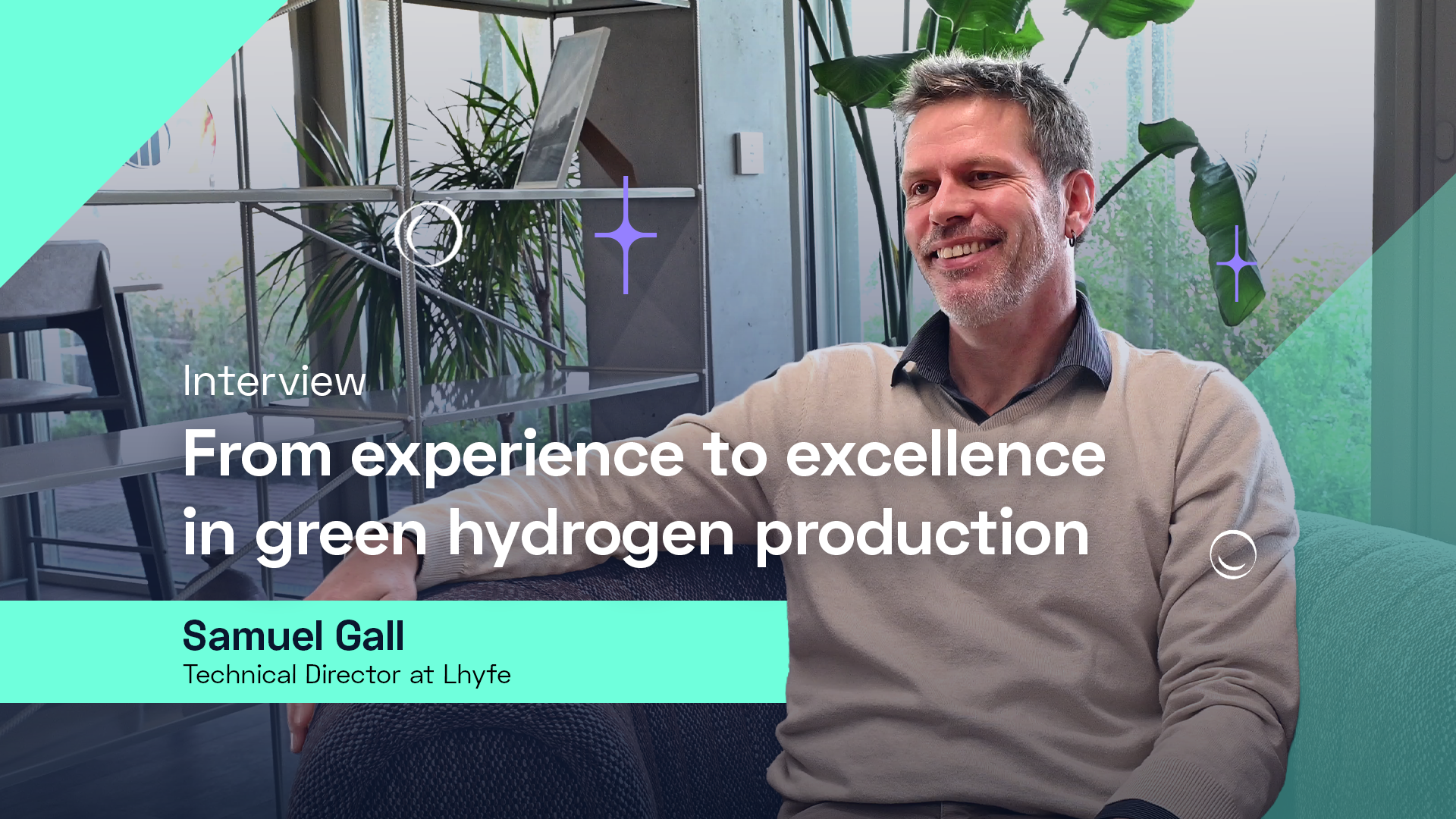
Hello Sam, could you please introduce yourself?
Sure, my name is Samuel Gall. I am 48 years old, a father of five children, and I currently serve as Chief Technical Officer at Lhyfe.
What has been your journey at Lhyfe, and what are your responsibilities today?
As Technical Director, I have contributed to the development of all plant projects in France and across Europe, from the design phase through to commissioning.
Beyond the technical and economic considerations, safety has always been a fundamental pillar in the development of our projects. From the earliest study phases, we systematically integrate risk analyses, local regulatory requirements and international standards applicable to hydrogen. Safety is not an additional step in our projects; it forms their structural foundation.
Which hydrogen production sites have you worked on at Lhyfe?
I have worked on all of Lhyfe’s production sites currently in operation, from the design phase through to commissioning. As a member of the engineering office, my scope covers plant design, technical engineering, documentation development, as well as supervision of construction, installation and commissioning phases.
The first site in Bouin (Vendée) was developed with a small team, requiring a high degree of versatility. I then contributed to the first industrial projects in France, notably Buléon and Bessières, as well as the site in Schwäbisch Gmünd (Germany), which is currently continuing its commercial and industrial ramp-up. I have also worked on the French projects in Le Cheylas and Croixrault, which have passed the Final Investment Decision (FID) and are now under construction.
Across each of these sites, industrial safety has been central to design decisions: rules of the equipment layout, ATEX zoning, hydrogen detection systems, ventilation, emergency shutdown systems and critical redundancies.
Are all Lhyfe’s hydrogen production sites identical?
No, Lhyfe’s hydrogen production sites are not strictly identical. Beyond installed capacity, each project is designed according to available technologies, site constraints and industrial objectives. Lhyfe has strong expertise in the selection and integration of equipment, particularly electrolysers and compressors, mastering the specific features of different manufacturers and technologies available on the market.
The technological choice therefore does not depend solely on plant capacity, but also on criteria such as robustness, industrial maturity, compactness and ease of deployment as well as the profile of customer demand for hydrogen. For example, the Bouin site is based on atmospheric alkaline electrolysis technology, recognised for its reliability and established industrial track record.
For the next-generation sites — Buléon, Bessières and Schwäbisch Gmünd — Lhyfe selected PEM (Proton Exchange Membrane) technology, which is more compact and compatible with containerised electrolysers. This approach significantly simplifies civil engineering works, reduces building costs and accelerates construction and installation phases.
Each site therefore benefits from an optimised design combining industrial performance, cost control and operational efficiency, while contributing to the progressive industrialisation of green hydrogen production.
How does Lhyfe operate its plants and ensure safe operations?
Lhyfe operates its hydrogen production plants remotely using advanced automation systems. Each site is equipped with an industrial control system enabling real-time supervision of critical parameters: pressure, temperature, hydrogen purity, electricity consumption, equipment status and safety systems.
Remote operation does not replace human presence; rather, it strengthens it. It enables operations teams to intervene in a targeted, informed and proactive manner. This approach improves plant availability, optimises preventive maintenance and significantly enhances the overall safety level of the sites.
How does Lhyfe capitalise on its technical expertise across its international teams?
Capturing experience and technical expertise at an international level is a major strategic challenge for Lhyfe. From the first developments outside France, particularly in Germany, it became necessary to align teams from different cultures and practices, while the engineering office has historically been based in France.
To address this challenge, we implemented standardised internal technical processes clearly defining how a hydrogen project is developed at Lhyfe. The objective is to guarantee a consistent approach, regardless of the country, team or project manager, by minimising uncertainty in technical studies as much as possible.
These shared methodologies ensure reliability of results, consistency of technical assumptions and comparability of projects, irrespective of geographical location. They are, however, designed to remain sufficiently flexible to adapt to regulatory requirements and safety standards specific to each region, which may vary significantly from one country to another.
Thanks to these structured processes, all international teams can rely on the expertise developed in France while efficiently deploying green hydrogen projects across Europe.