
Published the 19/03/2026
Decarbonising worksites: a new standard for the construction sector
Reducing CO₂ emissions is no longer optional in the construction industry. Increasingly, project owners are incorporating strong environmental requirements into their tenders, pushing construction and civil engineering companies to find concrete solutions to decarbonise their operations—including auxiliary uses such as site compounds and small repair workshops.
These temporary installations still require energy, often in areas where connection to the electricity grid is not yet available or technically feasible. As a result, they still largely rely on conventional diesel generators.
This is precisely where EODev and Lhyfe come in, offering a zero-emission (at point of use) energy solution capable of meeting these needs in a clean way—already deployed under real-world conditions.
EODev: from experimentation to industrial-scale hydrogen solutions
EODev (Energy Observer Developments) is an industrial spin-off from the Energy Observer project—the world’s first self-sufficient hydrogen-powered vessel, which travelled the globe for seven years. Building on this unique experience, the company’s mission is to industrialise clean energy solutions based on hydrogen.
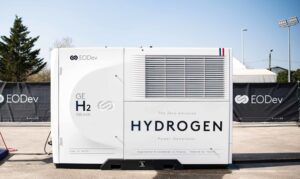
The GEH2® is a hydrogen-powered generator designed to replace traditional diesel units. Quiet and free from direct CO₂ emissions and fine particles, it provides clean, reliable electricity for temporary or off-grid applications, such as construction sites.
Why green hydrogen is a game changer for worksites
On a construction site, the challenge is not just to slightly reduce emissions, but in some cases to achieve genuine zero emissions—particularly when required by the client. For committed companies such as the Karp-Kneip Group, there is no room for half measures: environmental consistency requires the use of hydrogen produced from renewable electricity.
For worksites requiring continuous power supply, green hydrogen offers a temporary energy solution capable of delivering low-carbon electricity with high autonomy, while meeting on-site operational constraints.
This is where Lhyfe comes in—a producer of green and renewable hydrogen in Europe. When used in EODev’s GEH2®, this hydrogen enables on-site electricity generation with zero emissions at the point of use and a significantly reduced carbon footprint across the entire value chain, especially compared with an equivalent diesel solution.
The result: site compounds and workshops powered by decarbonised energy, without compromising on performance.
A real-world example: a decarbonised roadworks project near Carcassonne
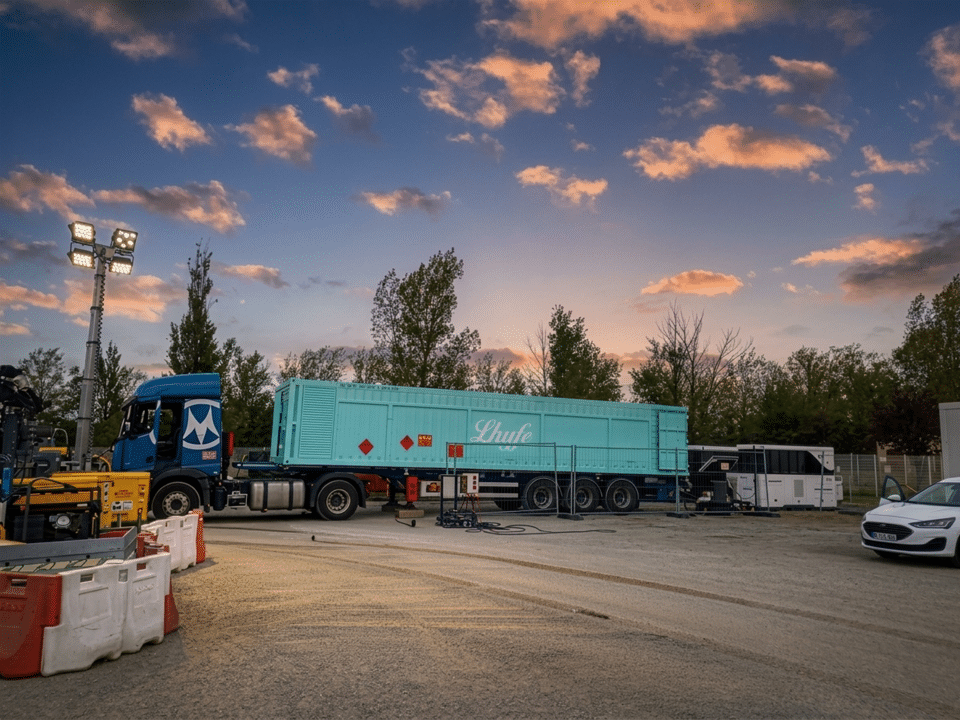
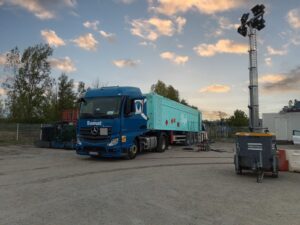
This solution has already been implemented on a motorway resurfacing project near Carcassonne. Over several months, both the site compound and the small repair workshop were powered by two hydrogen generators supplied by EODev and fuelled with green hydrogen provided by Lhyfe.
The approach is designed to be simple and safe for on-site teams. EODev delivers a turnkey solution and supports operators during installation and commissioning. The system ensures service continuity, notably through a modular architecture that allows temporary switching to battery power during hydrogen container replacement.
Meanwhile, Lhyfe manages logistics and provides training to teams on handling and replacing hydrogen containers. The objective is clear: enable site managers to focus on their core activities while benefiting from a decarbonised, reliable and easy-to-integrate energy solution.
A solution already deployed and ready to scale
Today, EODev is deploying its hydrogen solutions across numerous projects in France and internationally. The company is now present in more than 30 countries worldwide and continues to expand to support the energy transition across multiple sectors.
This operational presence enables valuable feedback from real-life use cases, allowing equipment to be continuously adapted to on-site realities. It also forms part of a broader acceleration in hydrogen adoption, made possible by the gradual expansion of green hydrogen production and distribution capacities by Lhyfe across Europe.
Green hydrogen and zero-emission worksites: a future-proof choice
Decarbonising construction sites will not happen overnight, but solutions already exist. The partnership between EODev and Lhyfe demonstrates that it is now possible to replace diesel generators with a clean, operational alternative tailored to real-world constraints.
For construction stakeholders, this represents an opportunity to meet new environmental requirements, strengthen their position in tenders, and actively contribute to the energy transition.
Green hydrogen is no longer a distant promise—it is already at work on construction sites, helping to decarbonise the sector today.