
Published the 19/05/2026
In the face of the climate emergency, certain sectors remain particularly difficult to decarbonise: heavy industry, long-distance transport, gas-intensive applications… Where direct electrification is not sufficient, renewable hydrogen and its derivatives, such as e-methane, offer concrete and already operational solutions that are further supported by French and European regulations.
To better understand these solutions, we spoke to Nicolas Jensen, who leads Enosis’s development in Southern Europe and North America, as well as the company’s institutional relations.
Enosis: converting CO₂ and hydrogen into renewable gas
Enosis is both an equipment manufacturer and a developer of e-methane production projects based on a technology known as biological methanation.
The principle: combining CO₂ or biogas on one side and hydrogen on the other. The process: biological methanation. Through the action of bacteria, this mixture is converted into e-methane, a synthetic gas capable of replacing fossil natural gas without requiring any changes to existing transport and distribution infrastructure. When the CO₂ is biogenic and the hydrogen is renewable or low-carbon, the gas produced is renewable or low-carbon.
When the methanation units and the electrolysers used for hydrogen production are integrated on the same site, these are referred to as ‘Power-to-Methane’ facilities.
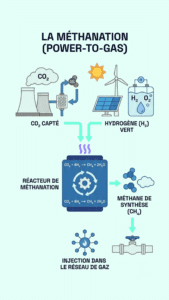
When coupled with anaerobic digestion sites, Power-to-Methane facilities enable the CO2 that these sites release into the air to be utilised and, without increasing the size of the sites, boost their production of renewable methane, which can thus be almost doubled. In doing so, the integration of the anaerobic digestion and Power-to-Methane sectors addresses the challenges of the National Low-Carbon Strategy regarding the responsible use of biomass for energy purposes.
For players in the energy and industrial sectors who currently use natural gas, this means one crucial thing: having access to renewable or low-carbon gas that is compatible with existing infrastructure and can therefore be used without the need for further investment in their current facilities.
Why are hydrogen and renewable or low-carbon methane key drivers of decarbonisation?
Hydrogen and renewable or low-carbon methane are essential energy carriers for supporting the decarbonisation of our societies, particularly for decarbonising applications that cannot be easily electrified. They play a key role where energy requirements are high and continuous, or where high energy density or very high temperatures are required.
This is particularly the case in energy-intensive industries such as steelmaking, heavy land and sea transport, as well as certain applications requiring gaseous or liquid fuels. In these sectors, solutions that are easy to implement are the most urgent, as alternatives based solely on electricity often remain limited.
Whilst the planning, construction, adaptation and interconnection of hydrogen transport and distribution networks is a long-term process, the production of renewable or low-carbon e-methane complements hydrogen production and enables hydrogen to be made immediately compatible with the existing gas network, for industrial uses or heavy-duty transport.
A concrete Enosis project: Dénobio, an industrial demonstration plant, where Lhyfe supplies the hydrogen
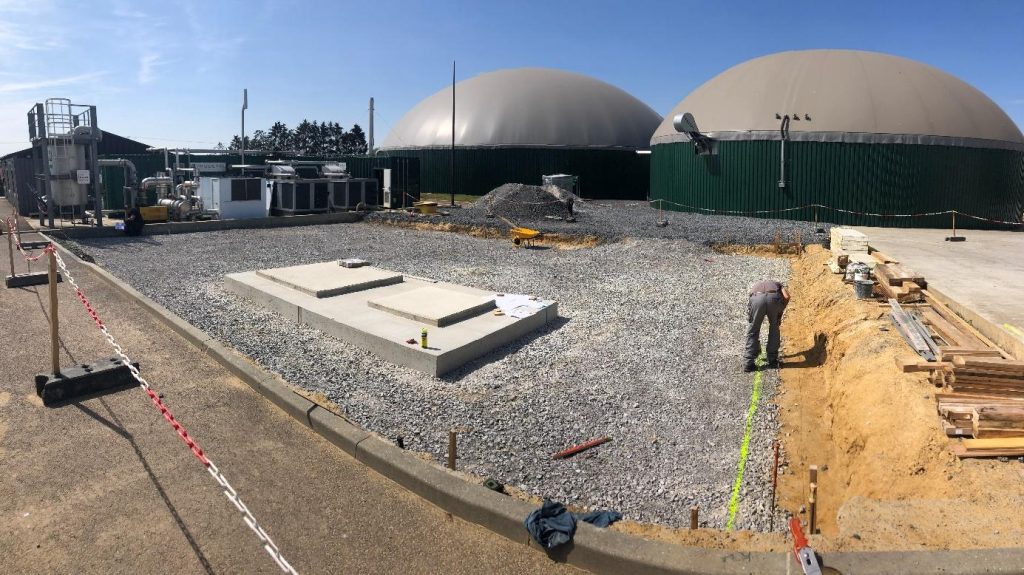
Dénobio is the first industrial-scale facility designed and operated by Enosis. Located in Lesquielles-Saint-Germain, in the Hauts-de-France region, Dénobio is integrated into an agricultural anaerobic digestion plant, Energia Thiérache.
Dénobio consists in particular of a biological methanation unit that processes either the CO₂ emitted by the methanation site or, directly, the biogas produced by the site. The hydrogen required for the process is supplied by Lhyfe, which delivers it by lorry. The gas produced by Dénobio—either e-methane or a mixture of e-methane and biomethane—is then injected directly into the natural gas network operated by GRDF. Since commissioning in April 2025, nearly 300 MWh of gas has been injected in this way.
Dénobio demonstrates that it is possible to:
- produce e-methane that can be injected immediately and stored in the natural gas network.
- decarbonise gas applications without modifying downstream industrial equipment and processes.
- Develop new business models that utilise biogenic CO₂ produced by agricultural anaerobic digestion plants, as well as by wastewater treatment plants.
The challenges
Meeting European demand, which already exists and is becoming more established.
On the one hand, the renewable methane market is becoming Europeanised, and certain players are beginning to diversify their supply of renewable methane, whilst biomethane production alone appears unlikely to be sufficient to meet growing demand.
On the other hand, regulatory frameworks tailored to consumption are being developed, with mechanisms that may vary from one European country to another. These mechanisms, based for example on European regulations such as the Renewable Energy Directive (RED) or the FuelEU Maritime Regulation aimed at decarbonising transport and industry, incorporate blending obligations backed by penalties in the event of non-compliance, and/or incentive schemes through the introduction of multipliers. In France, the IRICC mechanism (Incentive to Reduce the Carbon Intensity of Fuels) could draw inspiration from this (discussions led by the public authorities are currently underway).
In Europe, certain countries are also emerging as more conducive to e-methane production. These are the countries where the conditions for producing renewable or low-carbon hydrogen, driven by regulation, are most easily met, with the potential to optimise the costs of electrolysers, particularly their electricity supply.
What will the sector look like in 5 to 10 years’ time?
Recent geopolitical events are shaping a new world, where multilateralism is giving way to conflicts that are disrupting supply chains, particularly those for gas. In this context, despite the growth in electricity consumption, gas remains a strategic asset and ensuring its long-term supply is key. Developing biomethane and e-methane production sectors within our regions – which are key to energy independence – is therefore just as important.
Added to this are climate challenges… which must not be forgotten. Hydrogen and renewable e-methane molecules are capable of playing a central role in achieving greenhouse gas emission reduction targets. By 2030, they can already contribute to this in industry, heavy-duty transport and the production of alternative fuels and gases. Furthermore, the Power-to-Methane sector, by linking the hydrogen and biogas sectors through local, circular and scalable solutions, enables the utilisation of surplus electricity as well as CO2 that would otherwise be emitted into the atmosphere.
Why does this matter to you?
For manufacturers, energy companies, farmers, transport operators and local authorities, these solutions represent much more than just a technological innovation. They offer a realistic way to reinvent their business models, reduce CO₂ emissions, meet regulatory requirements and prepare for the future of energy without having to wait for a complete overhaul of the infrastructure.
Renewable hydrogen and e-methane are no longer distant promises: today, they are concrete energy sources for decarbonising even the most complex applications.