
Alstom
Industries

Significant reduction in CO₂ emissions on non-electrified lines

Alternative concrète et déployable rapidement au diesel ferroviaire

Contribution to the development of the hydrogen sector in France

Local production of renewable hydrogen, rooted in local communities
A major challenge for French rail transport
In France, thousands of kilometres of railway lines are not electrified. Transport operators face two options: to electrify the lines – a lengthy and costly project – or to find a clean alternative to diesel trains.
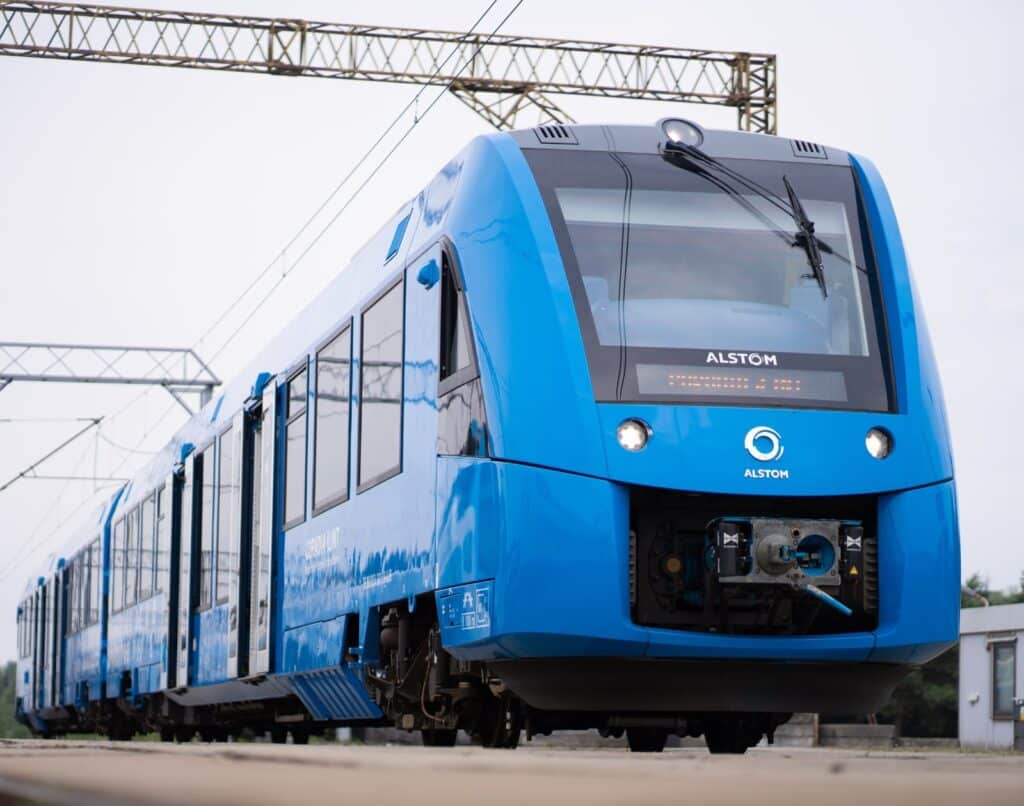
It is against this backdrop that Alstom, the world leader in sustainable mobility solutions, committed in 2019 to developing hydrogen-powered trains, in partnership with SNCF Voyageurs and several French regions.
The challenge: to design, test and validate dual-mode electric-hydrogen trains capable of gradually replacing diesel trains on non-electrified regional lines.
Lhyfe’s proposal: a supply of renewable hydrogen for the testing phases
To power the fuel cell tests at its Tarbes site, Alstom turned to Lhyfe. Lhyfe supplies locally produced renewable hydrogen from the Bessières site (80 per cent owned by Lhyfe and 20 per cent by AREC Occitanie), enabling Alstom to test and validate the on-board energy systems of its trains under real-world conditions.
Lhyfe already has practical experience in this field, particularly in Germany, where the company has collaborated with Deutsche Bahn on the development and testing of trains powered by green hydrogen under real-world operating conditions. This experience further reinforces the relevance and reliability of the tests currently being carried out in France.
This partnership forms part of a broader sector-wide initiative, bringing together manufacturers, rail operators, local authorities and central government around a common goal: to establish the hydrogen ecosystem in France and accelerate the decarbonisation of regional transport.
Why renewable hydrogen is the right solution
Renewable hydrogen offers a faster, more flexible and more cost-effective alternative to the electrification of railway lines. Whereas installing overhead lines takes years and requires substantial budgets, a hydrogen-powered train can run on any existing line without the need to deploy major infrastructure.
It is this compatibility with the existing rail network that makes hydrogen particularly well-suited to decarbonising regional lines and positions this Alstom project as a landmark development for the entire French rail sector.
What this project says about Lhyfe
This partnership with Alstom demonstrates Lhyfe’s ability to integrate into complex industrial projects, to supply reliable renewable hydrogen for high-precision applications, and to make a tangible contribution to the decarbonisation of sectors with significant climate challenges.
It also confirms Lhyfe’s role as a leading partner for sustainable mobility stakeholders, working alongside manufacturers, operators and local authorities that are opting for green hydrogen.